Laser Cleaning Machine: Complete Guide to Industrial Rust Removal & Surface Preparation
Introduction
Rust, paint, grease, oxides, and contaminants cost manufacturers billions of dollars in downtime, rework, and failed inspections every year. Traditional surface cleaning methods — sandblasting, chemical stripping, mechanical grinding — are slow, messy, and generate hazardous waste.
**Laser cleaning machines** offer a fundamentally better approach: fast, precise, non-contact surface cleaning with **zero consumables** and **zero chemical waste**. In this guide, we explain how laser cleaning works, where it's used, and how to choose the right machine for your application.
---
What Is a Laser Cleaning Machine?
A laser cleaning machine uses a focused, high-intensity laser beam to remove contaminants from a surface through a process called **laser ablation**. The laser energy is absorbed by the contaminant layer (rust, paint, grease, oxide), causing it to rapidly vaporize or be ejected as fine particles — leaving the underlying metal surface clean and intact.
The key advantage: **the laser selectively removes the contaminant without damaging the base material** (when parameters are correctly set).
---
How Laser Cleaning Works: The Science Behind It
The physics is elegant:
1. **Selective Absorption:** Contaminants like rust and paint absorb laser energy far more efficiently than clean metal.
2. **Thermal Expansion & Ablation:** The absorbed energy causes the contaminant to heat rapidly, expand, and either vaporize (ablation) or be ejected as microscopic particles by thermal shock.
3. **Base Material Safety:** The underlying metal reflects most of the laser energy, so it remains at safe temperatures.
4. **Fume Extraction:** A built-in or external fume extractor collects the particles and vapors produced.
The result is a **dry, chemical-free, contact-free cleaning process** that can be precisely controlled.
---
Types of Laser Cleaning Machines
1. Pulsed Fiber Laser Cleaners
**Best for:** Paint removal, fine rust, precision cleaning, historical artifact restoration
- Very low heat input — excellent for heat-sensitive materials
- Can clean without any surface damage
- Typical power: 20W – 500W
- More precise control over cleaning depth
2. Continuous Wave (CW) Fiber Laser Cleaners
**Best for:** Heavy rust removal, weld seam cleaning, large surface areas, industrial production
- Faster cleaning rates than pulsed
- Better for thick rust and thick coatings
- Typical power: 100W – 3000W
- Common in automotive, shipbuilding, and steel fabrication
3. Handheld Laser Cleaners
The most versatile form factor. The operator holds a lightweight gun and sweeps it over the surface. Ideal for:
- Irregular surfaces and complex geometries
- Field maintenance and repair
- On-site rust treatment
4. Automated / Robot-Mounted Laser Cleaners
Integrated into production lines or mounted on robotic arms for high-throughput, consistent cleaning of parts at scale.
---
Laser Cleaning vs. Traditional Methods
| Method | Speed | Chemical Waste | Surface Damage Risk | Media/Consumable Cost | Precision |
|--------|-------|----------------|--------------------|-----------------------|-----------|
| **Laser Cleaning** | Fast | None | Very Low | None | Very High |
| Sandblasting | Medium | Low | Medium–High | Sand media | Low |
| Chemical Stripping | Slow | High (toxic) | Low–Medium | Chemicals | Medium |
| Mechanical Grinding | Medium | None | Medium–High | Grinding wheels | Low |
| Dry Ice Blasting | Medium | None | Low | Dry ice | Medium |
| Ultrasonic Cleaning | Slow | Solvent waste | Low | Chemicals | High (small parts) |
**Laser cleaning eliminates the most critical pain points:** no hazardous waste disposal, no abrasive media, no chemical handling, and no surface texture damage.
---
Key Applications of Laser Cleaning Machines
1. Rust Removal (Pre-Welding & Maintenance)
Laser cleaning is widely used to remove rust from steel surfaces before welding, painting, or coating. Clean welds start with clean metal.
**Industries:** Shipbuilding, construction, structural steel, heavy machinery maintenance
2. Paint & Coating Removal
Strip paint, epoxy coatings, anti-corrosion coatings, and rubber coatings without affecting the substrate.
**Industries:** Automotive remanufacturing, aerospace, bridge and infrastructure maintenance
3. Weld Seam Cleaning (Pre & Post-Weld)
Before welding: remove oxide layers, oils, and mill scale for better weld quality.
After welding: remove discoloration, weld spatter, and heat-affected oxidation.
**Industries:** Stainless steel fabrication, food processing equipment, pharmaceutical equipment
4. Mold Cleaning
Clean rubber and plastic injection molds in-situ — no disassembly required. Removes rubber residue, release agents, and carbon deposits.
**Industries:** Automotive (tire molds, rubber seals), plastics manufacturing
5. Cultural Heritage & Art Restoration
Low-power pulsed laser cleaning is the gold standard for cleaning stone monuments, bronze sculptures, and historical artifacts — removing black crust, graffiti, and biological growth.
**Industries:** Museums, conservation professionals, monument restoration
6. Electronic Component Cleaning
Remove oxides from solder joints, PCB tracks, and metal connectors with extreme precision.
**Industries:** Electronics manufacturing, aerospace electronics
7. Nuclear & Hazardous Facility Decontamination
The non-contact nature of laser cleaning makes it ideal for radioactive surface decontamination without spreading contaminated water or chemicals.
---
Choosing the Right Laser Cleaning Machine
Step 1: Define the Contaminant & Substrate
| Contaminant Type | Recommended Mode | Power Range |
|-----------------|------------------|-------------|
| Light rust, thin oxides | Pulsed | 50W – 200W |
| Heavy rust, thick scale | CW or High-Power Pulsed | 500W – 2000W |
| Paint (single layer) | Pulsed | 100W – 500W |
| Multi-layer paint | CW | 500W – 1500W |
| Grease & oil | Pulsed or CW | 100W – 500W |
| Weld spatter & discoloration | Pulsed or CW | 200W – 1000W |
| Mold cleaning | Pulsed | 50W – 200W |
Step 2: Determine Production Scale
- **Small workshop / occasional use:** 100W–300W handheld pulsed cleaner
- **Medium production facility:** 500W–1000W CW handheld cleaner
- **High-volume production line:** 1500W–3000W automated system
Step 3: Consider Portability
Handheld laser cleaners are available in portable suitcase-form units — ideal for field service and maintenance work.
Step 4: Safety Requirements
Laser cleaning produces fumes, vapors, and fine particles. Always ensure:
- Proper fume extraction (built-in or external)
- Laser safety goggles rated for 1064nm
- Enclosed work area or appropriate safety enclosure
- Staff training on laser safety protocols
---
Laser Cleaning Machine Price Guide (2026)
| Type & Power | Estimated Price (USD) |
|-------------|----------------------|
| 100W Pulsed Handheld | $3,000 – $6,000 |
| 200W Pulsed Handheld | $5,000 – $9,000 |
| 500W Pulsed Handheld | $9,000 – $18,000 |
| 1000W CW Handheld | $5,000 – $12,000 |
| 1500W CW Handheld | $8,000 – $16,000 |
| 2000W–3000W CW Industrial | $15,000 – $35,000 |
*CW (continuous wave) machines are generally less expensive than pulsed at equivalent power levels.*
---
Remcor Technology Laser Cleaning Machines
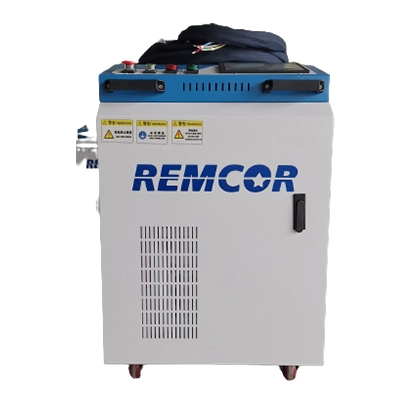
**Remcor Technology** offers a comprehensive range of handheld laser cleaning machines, covering both **pulsed** and **continuous wave** configurations:
- ✅ Power range: 100W to 3000W
- ✅ Handheld gun design with ergonomic grip
- ✅ Integrated cooling and fume extraction compatibility
- ✅ Multiple cleaning nozzles for different surface geometries
- ✅ Real-time power adjustment for different contaminant thicknesses
- ✅ CE Certified, exported to 40+ countries
- ✅ Available as standalone units or as part of 3-in-1 laser systems
Whether you need to strip paint from automotive parts, clean weld seams on stainless steel vessels, or maintain molds in a rubber manufacturing facility, Remcor has a laser cleaning solution tailored to your process.
---
Return on Investment: Is Laser Cleaning Worth It?
The economics are compelling when you factor in total cost of ownership:
| Cost Factor | Traditional Cleaning | Laser Cleaning |
|-------------|---------------------|----------------|
| Consumables (annual) | $5,000 – $50,000 | Near zero |
| Chemical disposal | $2,000 – $20,000 | Zero |
| Labor hours | High | Reduced by 50–80% |
| Equipment maintenance | Moderate | Minimal |
| Environmental compliance | Ongoing costs | Minimal |
For facilities cleaning surfaces daily, a laser cleaner typically **pays for itself within 6–24 months** depending on the application.
---
Frequently Asked Questions
**Q: Will laser cleaning damage the base metal?**
A: When parameters (power, scan speed, frequency) are correctly set, the base metal is not damaged. The laser selectively removes the contaminant. For sensitive applications, pulsed mode minimizes heat input further.
**Q: Is laser cleaning safe for use on thin sheet metal?**
A: Yes — pulsed laser cleaning is regularly used on thin stainless steel (as thin as 0.5mm) for weld seam cleaning without distortion.
**Q: How fast can a laser cleaner remove rust?**
A: A 1000W CW laser cleaner can clean approximately 10–40 m² per hour depending on rust thickness — significantly faster than manual grinding.
**Q: Does laser cleaning require consumables?**
A: No consumables. The only running cost is electricity and occasional replacement of the protective lens in the laser head (typically every 3–6 months in heavy use).
**Q: Can I use a laser cleaning machine outdoors?**
A: Yes. Portable handheld units are designed for field use. Ensure adequate fume extraction and eye protection for outdoor operation.
---
Conclusion
Laser cleaning machines represent the future of industrial surface preparation — delivering faster, cleaner, and more environmentally responsible results than any traditional method. Whether you're dealing with rust, paint, oil, or weld spatter, the right laser cleaning system will transform your surface treatment process.
**Remcor Technology** offers a complete range of laser cleaning machines backed by proven manufacturing quality and global service support.
**[Explore Laser Cleaning Machines at Remcor Technology](https://www.remcortechnology.com)**

 English
 русский
 français
 Deutsch
 Español