Mar 02 , 2026
Welding is one of the most critical processes in modern metal fabrication, automotive manufacturing, aerospace production, and sheet metal processing. Two of the most widely used welding technologies today are the laser welding machine and the MIG welding machine.
A fiber laser welding machine uses a highly concentrated laser beam to fuse metals with minimal heat input and extremely high precision. In contrast, a MIG welding machine (Metal Inert Gas welding) relies on a continuously fed wire electrode and shielding gas to create a weld pool.
With the rise of advanced equipment such as the portable MIG laser welding machine and handheld laser welder machine, many manufacturers are beginning to reconsider traditional welding methods.
This article will compare the laser welder and MIG welding machine in terms of strength, weld quality, material compatibility, application scenarios, and cost efficiency to help manufacturers choose the right technology.
Weld strength is one of the most important factors when choosing between a laser welding machine and a MIG welding machine.
A fiber laser welding machine produces a deep, narrow weld with a high energy density laser beam. This concentrated heat source allows the laser welder machine to penetrate materials quickly while minimizing the heat-affected zone.
Advantages of laser welding strength:
Deep penetration with narrow weld seams
Minimal material distortion
Strong metallurgical bonding
Consistent weld quality through CNC or automated control
By comparison, a MIG welding machine produces wider weld beads due to its arc-based heating method. While MIG welding is still capable of producing strong welds, the larger heat input can lead to greater distortion and post-processing requirements.
In many thin-metal applications such as stainless steel fabrication, electronics housings, and precision components, the laser welder often produces stronger and cleaner welds than a conventional MIG welding machine.
However, for very thick materials or heavy structural welding, MIG welding may still be preferred due to its robustness and lower equipment cost.
To objectively compare welding methods, several weld integrity tests are used in industrial production.
Common testing methods include:
This test measures how much force a weld can withstand before breaking. Welds produced by a fiber laser welding machine often show high tensile strength due to the concentrated fusion zone.
Bend tests evaluate the flexibility and ductility of the weld. A well-controlled laser welder machine typically produces clean welds with minimal internal defects.
Microscopic analysis allows engineers to inspect the weld structure and detect porosity, cracks, or inclusions. Compared with traditional welding, a laser welding machine generally produces a more uniform microstructure.
Methods such as ultrasonic testing and X-ray inspection help ensure the weld quality meets industry standards.
Whether using a portable MIG laser welding machine or a traditional MIG welding machine, these tests are essential for verifying welding reliability in critical applications.
Different welding technologies perform differently depending on the material.
A fiber laser welding machine is particularly effective for stainless steel due to its precise heat control and minimal discoloration.
Both the laser welder machine and MIG welding machine can weld carbon steel effectively. However, laser welding usually produces cleaner seams with less spatter.
Aluminum welding requires precise heat control because of its high thermal conductivity. A laser welder can provide excellent results for thin aluminum sheets.
For thin materials, the laser welding machine clearly has an advantage because it reduces burn-through and distortion.
For thicker metals, a MIG welding machine may still be widely used due to its deeper filler material deposition.
Modern portable MIG laser welding machine systems now offer more flexibility, allowing manufacturers to handle multiple materials with higher efficiency.
The choice between a laser welding machine and a MIG welding machine often depends on the production environment.
A fiber laser welding machine is widely used in sheet metal fabrication due to its precision and automation capability.
Automotive manufacturers increasingly use laser welder machine systems for high-speed robotic welding.
A laser welder is ideal for aerospace components because it minimizes distortion and ensures high weld strength.
Stainless steel kitchen equipment manufacturers often choose laser welding machines for aesthetic weld seams and minimal polishing.
Traditional MIG welding machines remain common in heavy structural welding where thick materials are involved.
In recent years, the introduction of the portable MIG laser welding machine has made laser welding more accessible for small and medium-sized workshops.
Cost is one of the most important factors when manufacturers choose between a laser welding machine and a MIG welding machine.
A MIG welding machine usually has a lower initial purchase cost, which is why it has long been widely used in fabrication workshops. In comparison, a fiber laser welding machine or laser welder machine generally requires a higher initial investment due to advanced laser sources, cooling systems, and precision control components.
Although the initial price of a laser welding machine is higher, it often provides significant long-term savings. A laser welder typically offers:
Faster welding speed
Minimal post-processing
Reduced material distortion
Lower consumable usage
These advantages can greatly improve production efficiency in high-volume manufacturing.
Modern handheld laser welder machine systems and portable MIG laser welding machine solutions can reduce labor costs because they are easier to learn and operate compared with traditional welding equipment.
A fiber laser welding machine usually requires less routine maintenance than a MIG welding machine, since it does not rely heavily on consumable parts like contact tips, welding wires, and shielding gas systems.
Overall, while the MIG welding machine offers a lower entry cost, the productivity advantages of a laser welding machine often result in better long-term cost efficiency.
Operation difficulty is another important factor when selecting welding equipment.
A MIG welding machine requires skilled operators to maintain stable arc control, adjust welding parameters, and ensure proper welding angles and speed. Welders must also manage wire feed speed, shielding gas flow, and electrode positioning. Because of these factors, mastering a MIG welding machine often requires professional welding training and experience.
A laser welding machine, especially a handheld laser welder machine, is designed to be more user-friendly. The welding process relies on a highly focused laser beam generated by a fiber laser welding machine, and the machine parameters are usually pre-programmed.
Advantages of operating a laser welder include:
·
Easier operation with minimal welding experience
Stable welding quality
Less dependence on manual welding skills
Lower risk of welding defects such as spatter or uneven seams
Modern portable MIG laser welding machine equipment further simplifies welding operations, allowing operators to quickly learn the process and achieve consistent results.
As a result, many manufacturers prefer a laser welding machine when they want to reduce training time and improve production efficiency.
In recent years, more manufacturers have started adopting laser welding machines because of their precision, efficiency, and automation compatibility.
Handheld laser welder machine systems have become particularly popular in sheet metal fabrication, stainless steel processing, and custom metal product manufacturing.
Compared with traditional MIG welding machines, modern fiber laser welding machine systems provide:
·
Faster welding speeds
Cleaner and more attractive weld seams
Lower material deformation
Easier automation integration
The development of the portable MIG laser welding machine has also made laser welding more accessible for small and medium-sized workshops.
As industrial automation continues to expand, the laser welder is expected to become an increasingly important technology in modern metal fabrication.
Both the laser welding machine and the MIG welding machine play important roles in modern manufacturing.
A fiber laser welding machine offers excellent precision, high speed, and minimal distortion, making it ideal for thin materials, stainless steel fabrication, and high-precision industries.
Meanwhile, the MIG welding machine remains a reliable option for heavy structural welding and thicker materials.
With the growing availability of handheld laser welder machine systems and portable MIG laser welding machine solutions, more manufacturers are transitioning to laser technology to improve productivity and reduce operating costs.
When selecting a welding solution, companies should carefully consider material thickness, required weld quality, production volume, and operational efficiency.
| Comparison Factor | Laser Welding Machine | MIG Welding Machine |
|---|---|---|
| Welding Principle | A laser welding machine uses a highly focused laser beam generated by a fiber laser welding machine to melt and fuse metal materials with high precision. | A MIG welding machine uses an electric arc between a consumable wire electrode and the workpiece to create the weld pool. |
| Welding Precision | A laser welder machine provides extremely high precision and narrow weld seams with minimal heat-affected zones. | A MIG welding machine produces wider weld beads and larger heat-affected zones. |
| Welding Strength | A laser welder can create strong, deep-penetration welds, especially for thin metals and precision components. | A MIG welding machine produces strong welds but may require more filler material and post-processing. |
| Heat Input | The fiber laser welding machine delivers concentrated heat with minimal distortion to surrounding material. | The MIG welding machine generates more heat, which can cause greater material deformation. |
| Welding Speed | A laser welding machine generally offers faster welding speeds in automated or high-volume production. | A MIG welding machine usually operates at moderate speeds depending on operator skill. |
| Operation Difficulty | A handheld laser welder machine or portable MIG laser welding machine is easier to operate and requires less welding experience. | Operating a MIG welding machine requires skilled welders to control arc stability, speed, and welding angle. |
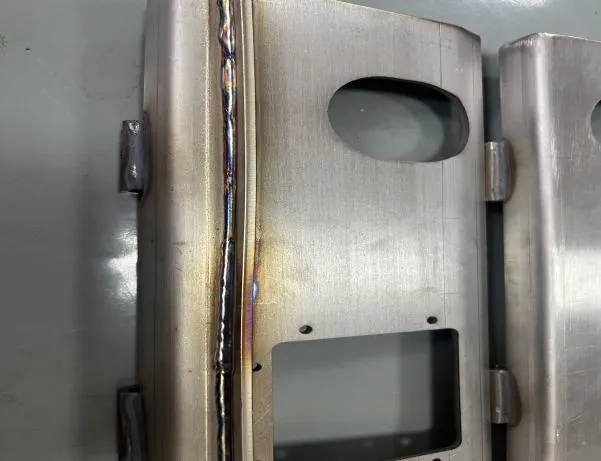
| Weld Appearance | Weld seams from a laser welder are typically smooth, narrow, and aesthetically clean with minimal spatter. | A MIG welding machine often produces visible weld beads and more spatter. |
| Material Compatibility | A laser welding machine works very well for stainless steel, carbon steel, aluminum, and thin sheet metal. | A MIG welding machine is commonly used for carbon steel and thicker structural materials. |
| Equipment Cost | A fiber laser welding machine has a higher initial investment due to advanced laser technology. | A MIG welding machine usually has a lower equipment cost. |
| Maintenance Requirements | A laser welder machine typically requires less maintenance because it has fewer consumables. | A MIG welding machine requires regular replacement of wires, tips, and shielding gas. |
| Typical Applications | A laser welding machine is widely used in sheet metal fabrication, automotive parts, electronics, kitchen equipment, and precision manufacturing. | A MIG welding machine is commonly used in construction, heavy fabrication, and structural welding. |
 English
 русский
 français
 Deutsch
 Español