Mar 13 , 2026
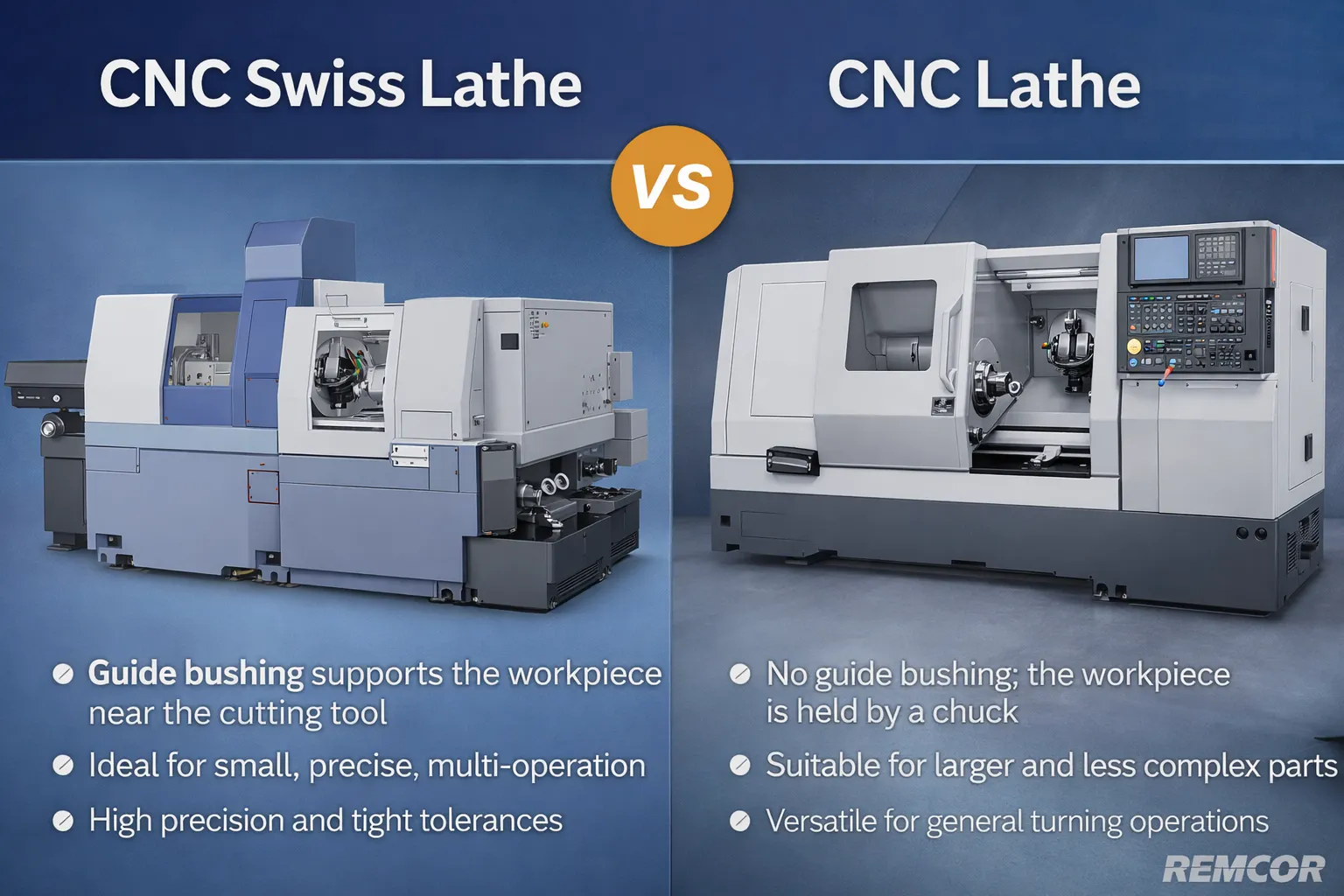
CNC Swiss lathes are among the most advanced machine tools used in precision manufacturing. Originally developed for the Swiss watchmaking industry, these machines are now widely used for producing high-precision components in industries such as medical devices, aerospace, automotive, electronics, and telecommunications.
What makes Swiss-type lathes unique is their ability to machine small, complex, and long slender parts with extremely tight tolerances. However, the performance of a CNC Swiss lathe does not rely solely on the machine itself. A wide range of auxiliary accessories and automation systems play a crucial role in maximizing machining efficiency, improving accuracy, and enabling unattended production.
Important accessories such as automatic bar feeders, high-pressure coolant systems, oil mist collectors, chip conveyors, oil coolers, electrical cabinet air conditioners, thread whirling units, and long part collection devices significantly enhance the overall productivity and reliability of Swiss-type machining.
This guide explores the most important CNC Swiss lathe accessories, their functions, advantages, and why they are essential for modern precision machining operations.
An automatic bar feeder is one of the most important accessories used with a swiss CNC lathe. It automatically feeds bar stock material into the machine spindle, allowing continuous machining without manual loading.
In Swiss-type turning, bar stock is pushed through the guide bushing and main spindle as the machining process progresses. After each part is cut off, the bar feeder advances the material forward so that the next component can be machined.
This automation dramatically increases productivity and allows lights-out manufacturing, where machines can operate unattended for extended periods.
Short bar feeders typically support bar lengths of 1 to 1.5 meters.
Advantages include:
Compact design
Lower cost
Suitable for small workshops
Easier installation
However, they require more frequent material loading.
Long bar feeders usually support 3–4 meter bar stock and are commonly used in high-volume production environments.
Key benefits include:
Longer unattended production time
Reduced operator intervention
Higher production efficiency
Stable bar feeding at high spindle speeds
Using a bar feeder provides several advantages:
Enables fully automated production
Reduces labor cost
Improves machining stability
Increases production capacity
Minimizes downtime between cycles
For high-volume parts manufacturing, a bar feeder is considered essential equipment for CNC Swiss lathes.
A high pressure coolant system delivers coolant at elevated pressure directly to the cutting tool and machining area.
Swiss-type lathes often machine small, deep holes and complex geometries where chip removal can be challenging. High pressure coolant systems help flush chips away from the cutting zone while maintaining effective cooling.
Typical coolant pressures include:
20 bar
40 bar
70 bar
100 bar
120 bar or higher
Machines used for deep hole drilling or difficult materials such as stainless steel, titanium, and superalloys often require coolant pressures above 70 bar.
High pressure coolant helps break chips into smaller pieces and removes them quickly from the cutting area.
This prevents:
Chip wrapping around tools
Tool damage
Surface scratches
By effectively cooling the cutting zone, high pressure coolant reduces thermal stress on cutting tools.
This results in:
Less tool wear
Longer tool life
Reduced tooling cost
Better chip control allows higher cutting speeds and feeds, increasing overall machining productivity.
During high-speed machining, cutting oil and coolant can create oil mist and fine airborne particles inside the machine enclosure. These particles may escape into the workshop environment if not properly controlled.
An oil mist collector removes these particles from the air and helps maintain a clean and safe working environment.
Oil mist collectors typically use a multi-stage filtration system, including:
Pre-filter for large particles
Centrifugal separation stage
High-efficiency filter element
Some systems also use electrostatic filtration technology to capture ultra-fine particles.
Installing an oil mist collector offers several benefits:
Improves operator health and safety
Maintains clean factory air
Reduces oil accumulation on machines and floors
Helps comply with environmental regulations
For factories operating multiple CNC machines, oil mist collectors are often part of the overall shop air quality management system.
High-precision machining requires stable temperature conditions. During continuous operation, machine components and lubrication systems generate heat, which can lead to thermal expansion and dimensional errors.
An oil cooler regulates the temperature of lubrication oil or hydraulic oil within the machine.
Oil coolers circulate machine oil through a heat exchanger system that removes excess heat.
The system maintains oil temperature within a stable range, typically around:
20–25°C (68–77°F)
Maintains machining accuracy
Prevents thermal deformation
Extends machine component life
Ensures stable lubrication
Temperature stability is especially important for tight tolerance parts used in medical and aerospace industries.
Modern CNC machines contain many sensitive electronic components, including:
CNC controllers
Servo drives
PLC units
Power modules
These components generate heat during operation.
An electrical cabinet air conditioner controls the temperature inside the electrical cabinet to protect these components.
Proper cooling provides several benefits:
Prevents overheating of electronic components
Reduces risk of system failure
Improves machine reliability
Extends lifespan of electrical systems
Maintaining stable cabinet temperature is particularly important in hot manufacturing environments.
A chip conveyor automatically removes metal chips generated during machining and transports them to a chip collection container.
Without proper chip removal, chips can accumulate inside the machine and interfere with machining operations.
The most common chip conveyor type used with Swiss lathes.
Suitable for:
Steel chips
Stainless steel chips
Aluminum chips
Brass chips
Used for handling fine chips or sludge-like materials.
Designed for transporting ferrous metal chips using magnetic force.
Chip conveyors provide several operational benefits:
Keeps machining area clean
Prevents chip accumulation
Improves coolant flow
Reduces machine downtime for cleaning
Efficient chip management is essential for maintaining stable long-term production.
A thread whirling unit is a specialized attachment used to produce high-precision threads.
This technology is commonly used for manufacturing:
Medical bone screws
Dental implants
Orthopedic screws
Aerospace threaded components
Thread whirling uses a rotating cutting ring with multiple inserts that rotates around the workpiece.
The cutting ring rotates at high speed while the workpiece rotates slowly. This combination allows precise and efficient thread generation.
Thread whirling can produce threads much faster than traditional thread cutting methods.
The multi-insert cutting process produces smooth thread surfaces with minimal burrs.
Thread whirling is capable of maintaining extremely tight tolerances required for medical applications.
Swiss lathes frequently produce long, slender components, such as shafts, pins, and medical instruments.
Without proper collection systems, finished parts may become damaged or mixed with metal chips.
A long part collection device ensures safe and organized handling of finished components.
Finished parts are transported using a conveyor belt to a storage container.
Parts gently slide down a channel into a collection tray.
Parts are separated and stored automatically in rotating bins.
Prevents part damage
Improves production organization
Supports automated production
Enables unattended machining
The guide bushing is a defining component of Swiss-type lathes.
Unlike conventional lathes, Swiss machines support the bar stock extremely close to the cutting point.
This design provides:
Exceptional rigidity
Reduced vibration
Improved dimensional accuracy
Better surface finish
Guide bushings allow Swiss lathes to machine long and slender parts with high precision.
A parts catcher collects finished components immediately after the cutoff operation.
Without a parts catcher, parts may fall into the chip conveyor or become damaged.
Parts catchers provide:
Safe handling of finished components
Protection for delicate surfaces
Improved automation
They are often integrated with automatic sorting systems or conveyors.
CNC lathes swiss type are powerful machines designed for producing high-precision components with exceptional accuracy and efficiency. However, their full potential can only be realized when combined with the right accessories and auxiliary systems.
Key accessories such as bar feeders, high pressure coolant systems, oil mist collectors, oil coolers, chip conveyors, thread whirling units, and automated part collection devices significantly enhance machining performance.
By integrating these systems, manufacturers can achieve:
Higher productivity
Longer tool life
Improved machining precision
Cleaner working environments
Fully automated production
For companies operating in high-precision manufacturing industries, selecting the right CNC Swiss lathe accessories is essential for maintaining competitive production capabilities and achieving consistent product quality.
And for a manufacturer in this CNC machining industry, all the supply chains for the above accessories are reliable quality and attractive prices, this is the basic understanding we should be responsible for our customers.
We also very welcome all the customers who can ask the suppliers for the above parts to reduce the cost and to get the satisfied accessories
 English
 русский
 français
 Deutsch
 Español