Mar 13 , 2026
When selecting a CNC Swiss lathe, one of the most important decisions manufacturers must make is whether to choose a single spindle CNC Swiss lathe or a double spindle CNC Swiss lathe. Both machine configurations are widely used in precision manufacturing industries such as medical device production, aerospace components, automotive parts, and electronic connectors.
The difference between single spindle and double spindle Swiss lathes significantly affects machining capability, production efficiency, complexity of parts that can be manufactured, and the overall automation level of the machining process.
In general, a single spindle CNC Swiss lathe usually operates with 3-axis machining, making it suitable for relatively simple turning operations. In contrast, a double spindle CNC Swiss lathe often includes 5-axis or multi-axis machining capability, allowing it to perform more complex operations such as back machining, milling, drilling, and threading in a single setup.
Understanding the differences between these two machine types is essential for selecting the most suitable solution for your production requirements.
A single spindle CNC Swiss lathe is a Swiss-type automatic lathe equipped with one main spindle responsible for holding and rotating the bar stock during machining operations.
This machine configuration focuses mainly on front-side machining operations, such as:
Turning
Drilling
Tapping
Grooving
Thread cutting
Simple milling operations
Single spindle machines are commonly used for producing simple cylindrical parts and components with moderate complexity.
Most single spindle CNC Swiss lathes operate with 3-axis machining, including:
X axis – tool movement in the radial direction
Z axis – tool movement along the spindle axis
C axis – spindle indexing for milling or drilling
Some advanced single spindle models may include additional tool stations, but they generally remain simpler than multi-spindle configurations.
Single spindle machines typically require lower initial investment, making them ideal for small to medium-sized workshops.
Because of the simpler structure and fewer axes, programming and operation are easier for operators and CNC programmers.
Single spindle machines are widely used for manufacturing:
Shafts
Pins
Bushings
Connectors
Small mechanical components
With fewer moving parts and simpler structure, maintenance and troubleshooting are easier compared with multi-spindle systems.
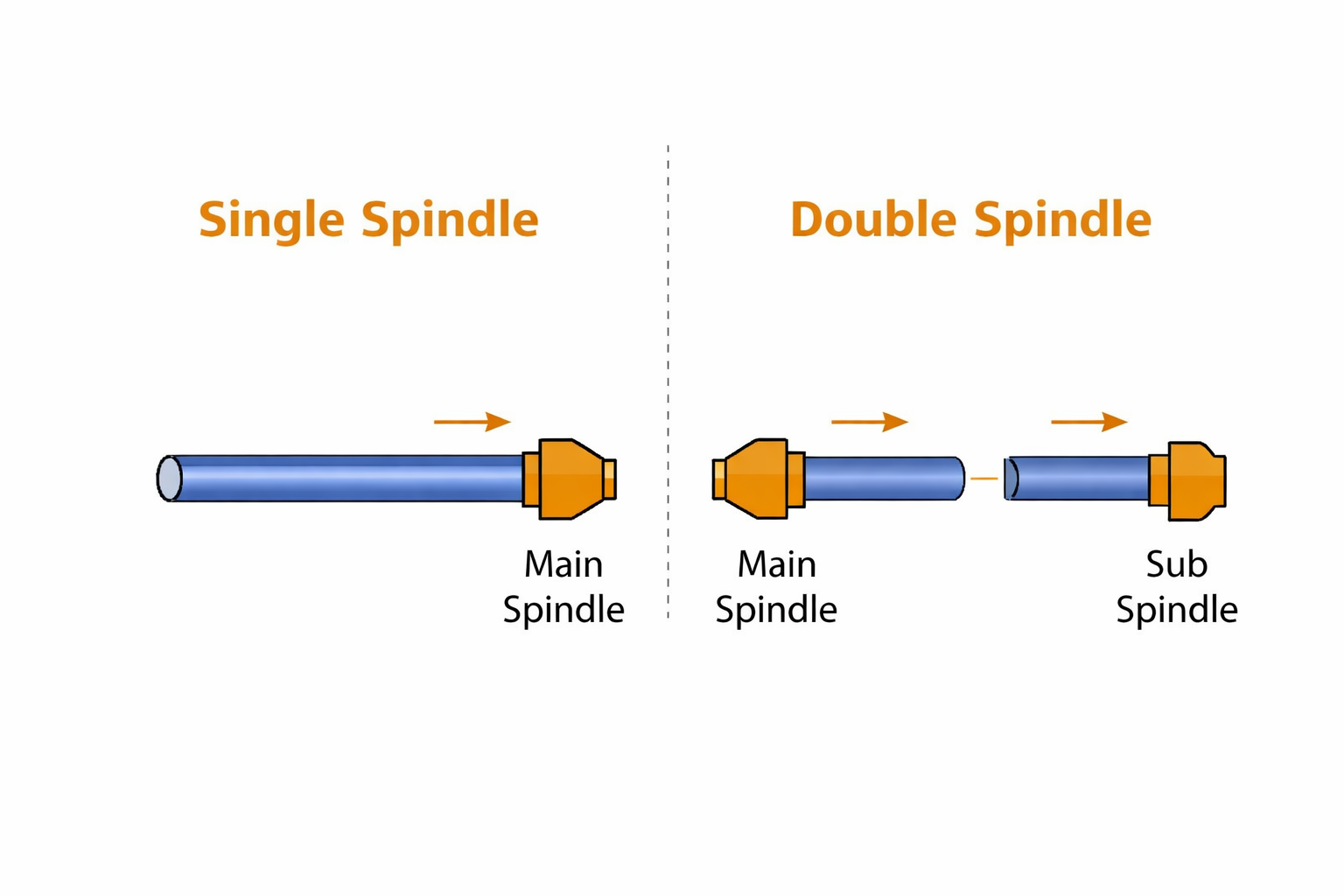
A double spindle CNC Swiss lathe is equipped with two spindles:
Main spindle
Sub spindle
The sub spindle allows the machine to perform back-side machining operations after the front-side operations are completed.
This enables the machine to produce fully finished parts in a single cycle, eliminating the need for secondary operations on another machine.
Most double spindle Swiss lathes operate with 5-axis machining or more, including:
X1 axis
Z1 axis
Y axis
C1 axis (main spindle)
C2 axis (sub spindle)
Some advanced models may include B-axis live tooling, enabling even more complex multi-axis machining.
The sub spindle allows parts to be transferred automatically for back machining operations such as:
Back drilling
Back threading
Back milling
End-face machining
This eliminates secondary operations and reduces production time.
Double spindle machines can perform simultaneous operations between the main spindle and sub spindle, improving cycle time and production efficiency.
Because they support multi-axis machining, double spindle Swiss lathes are ideal for producing complex precision components.
Typical parts include:
Medical implants
Aerospace connectors
Automotive sensor housings
Precision fasteners
Micro mechanical components
Since parts are finished in one machine cycle, there is no need for additional repositioning, which improves dimensional accuracy.
| Feature | Single Spindle CNC Swiss Lathe | Double Spindle CNC Swiss Lathe |
|---|---|---|
| Number of spindles | One spindle | Main spindle + sub spindle |
| Typical axis configuration | 3 axis | 5 axis or multi-axis |
| Machining capability | Front-side machining | Front and back machining |
| Production efficiency | Medium | High |
| Part complexity | Simple to moderate | Moderate to complex |
| Automation level | Basic automation | High automation |
| Machine cost | Lower | Higher |
| Setup flexibility | Limited | Very flexible |
Selecting the right machine depends on several important factors.
If your production mainly involves simple cylindrical parts, a single spindle CNC Swiss lathe is usually sufficient.
However, if your parts require multiple operations on both ends, a double spindle Swiss lathe will significantly reduce machining time.
For small batch production, single spindle machines may be more economical.
For high-volume production, double spindle machines offer better productivity due to their ability to complete parts in one cycle.
If cycle time and production efficiency are critical, double spindle machines provide major advantages through:
Simultaneous machining
Back-side operations
Reduced part handling
Single spindle Swiss lathes generally require lower investment, making them suitable for companies entering precision machining.
Double spindle machines require higher investment but deliver greater productivity and automation.
Many manufacturers choose double spindle multi-axis Swiss lathes because they offer greater flexibility for future product development.
If your company plans to produce more complex components, investing in a 5-axis CNC Swiss lathe with sub spindle can provide long-term advantages.
With the increasing demand for high-precision and complex parts, many manufacturers are moving toward multi-axis double spindle Swiss lathes.
These machines offer:
Complete machining in one cycle
Reduced labor cost
Higher productivity
Improved machining accuracy
Greater automation capability
Industries such as medical device manufacturing, aerospace engineering, and precision electronics particularly benefit from these advanced machining systems.
Understanding the differences between single spindle CNC Swiss lathes and double spindle CNC Swiss lathes is essential when selecting the right machine for your production needs.
A single spindle Swiss lathe is ideal for machining simple parts with lower investment cost and easier operation. In contrast, a double spindle multi-axis Swiss lathe provides higher efficiency, more complex machining capability, and full automation for modern precision manufacturing.
For manufacturers focused on high productivity, complex parts, and advanced multi-axis machining, the double spindle CNC Swiss lathe with 5-axis capability is becoming the preferred solution.
However, for companies producing standard components, a single spindle 3-axis Swiss lathe remains a reliable and cost-effective option.
Choosing the right configuration ultimately depends on part complexity, production volume, and long-term manufacturing goals.
 English
 русский
 français
 Deutsch
 Español