Sep 28 , 2026
A coil-fed laser cutting machine is generally a better choice for manufacturers requiring continuous production, higher material utilization, and reduced manual handling, while traditional sheet laser cutting remains suitable for low-volume production and operations using pre-cut metal sheets. The right solution depends on production volume, material requirements, workflow efficiency, and long-term manufacturing goals.
As manufacturers face increasing pressure to improve productivity and reduce operating costs, the comparison between coil fed laser cutting and traditional sheet laser cutting has become increasingly important. Understanding how these two approaches differ can help companies select the right laser cutting solution for their production environment.
The main difference lies in how raw materials are supplied and processed.
Traditional sheet laser cutting uses individual metal sheets that are already cut to a specific size. Operators load each sheet onto the cutting table, position it, complete the cutting process, and remove finished parts before loading the next sheet.
A coil laser cutting machine, on the other hand, processes metal directly from continuous coils. The system typically integrates coil loading, decoiling, leveling, feeding, and laser cutting into one automated production line.
This difference changes the entire manufacturing workflow. Instead of repeatedly handling separate sheets, manufacturers can achieve continuous material feeding with fewer production interruptions.
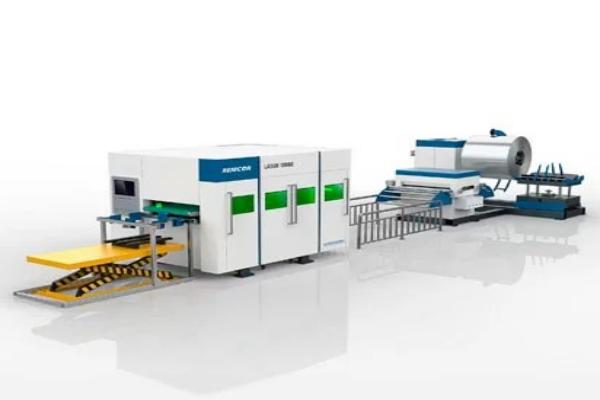
A coil-fed laser cutting machine improves efficiency by creating a continuous and automated processing flow. The material moves from the coil through leveling and feeding systems before reaching the laser cutting unit, allowing production to continue with minimal operator intervention.
Compared with traditional sheet processing, coil-fed systems offer several advantages:
Reduced loading and unloading time
Less manual material handling
More stable production speed
Higher output for repetitive components
For industries producing large quantities of metal parts, eliminating frequent sheet replacement can significantly improve overall equipment utilization.
High-volume manufacturing requires consistent production speed and predictable quality. Traditional sheet laser cutting can become inefficient when operators need to repeatedly load, align, and replace individual sheets.
With coil-fed laser cutting, manufacturers can process long lengths of material continuously. This makes the technology especially suitable for industries such as automotive components, electrical equipment, appliances, and metal fabrication.
The automated feeding process also helps maintain consistent positioning accuracy, reducing variations between different production batches.
Material utilization is one of the major advantages of a coil laser cutting machine.
Traditional sheet cutting often requires manufacturers to purchase or prepare sheets in fixed dimensions. Depending on part geometry, leftover material may become unusable scrap.
Coil-based laser cutting provides greater flexibility because the cutting pattern can be optimized across continuous material. Manufacturers can adjust nesting layouts more efficiently and reduce unnecessary waste.
For businesses processing expensive materials such as stainless steel or aluminum, improved material utilization can directly influence production costs.
Traditional sheet laser cutting still has advantages in certain production scenarios.
For manufacturers producing small batches, prototypes, or frequently changing part designs, individual sheets can provide greater convenience. Operators can quickly switch between different sheet sizes and materials without preparing a complete coil processing workflow.
However, for companies requiring repeat production and stable output, a coil-fed laser cutting machine usually provides better efficiency and automation benefits.
The choice depends on whether the priority is production flexibility for small orders or productivity for continuous manufacturing.
A complete coil-fed laser cutting machine combines several processing stages into one production solution. These typically include:
The coil loading system positions raw material for processing, while the decoiler releases the metal strip at a controlled speed.
Metal coils may contain stress or deformation after storage and transportation. Leveling equipment improves flatness before the material reaches the laser cutting area, helping maintain cutting accuracy.
The laser cutting system performs precise cutting operations according to programmed designs. Compared with mechanical cutting methods, laser technology enables complex shapes and detailed processing.
After cutting, finished components can be collected or transferred automatically, reducing additional handling requirements.
For continuous production environments, a coil-fed laser cutting machine can provide better long-term cost efficiency.
Although the initial investment may be higher than traditional sheet laser cutting equipment, manufacturers can achieve savings through:
Lower labor requirements
Reduced material waste
Faster production cycles
Improved production consistency
The return on investment becomes more significant when equipment operates for extended production hours and handles large quantities of components.
Industries that require high-volume, repeatable metal components can benefit significantly from coil-fed laser cutting technology.
Common applications include:
Automotive parts manufacturing
Electrical cabinets and enclosures
Home appliances
Construction components
Industrial equipment manufacturing
These industries often require consistent dimensions, efficient material usage, and reliable production capacity, making automated coil processing an attractive solution.
The best choice depends on several production factors:
Production volume is the first consideration. High-volume manufacturers usually benefit more from coil automation, while low-volume producers may prefer traditional sheet processing.
Material requirements also matter. Companies processing long production runs with consistent materials can take greater advantage of coil-fed systems.
Finally, manufacturers should consider future growth. Investing in automation can provide additional production capacity and reduce operational limitations as demand increases.
The comparison between a coil-fed laser cutting machine and traditional sheet laser cutting depends on production goals. Traditional sheet laser cutting remains practical for small batches, prototypes, and flexible material handling. However, for manufacturers seeking continuous operation, improved efficiency, and reduced production costs, coil-fed laser cutting provides significant advantages.
By integrating coil feeding, leveling, and laser cutting into one automated process, a modern coil-fed laser cutting machine helps manufacturers achieve higher productivity, better material utilization, and more consistent quality, making it a valuable solution for advanced sheet metal production.
A coil-fed laser cutting machine processes metal directly from coils by integrating feeding, leveling, and laser cutting operations into one automated system.
Yes. Coil laser cutting can achieve higher production efficiency by reducing manual loading and enabling continuous material processing.
They are widely used in automotive, electrical, appliance, construction, and industrial manufacturing applications.
Yes. Continuous coil processing allows better cutting optimization and improves material utilization.
It can be used for smaller runs, but it provides the greatest benefits in medium- and high-volume production environments.
This is the first one.
 English
 русский
 français
 Deutsch
 Español