Feb 07 , 2026
A panel bender (also called a panel bending machine, panel bending center, or CNC panel bender) is an advanced CNC-controlled sheet metal forming system specially designed for bending flat panels and box-type parts.
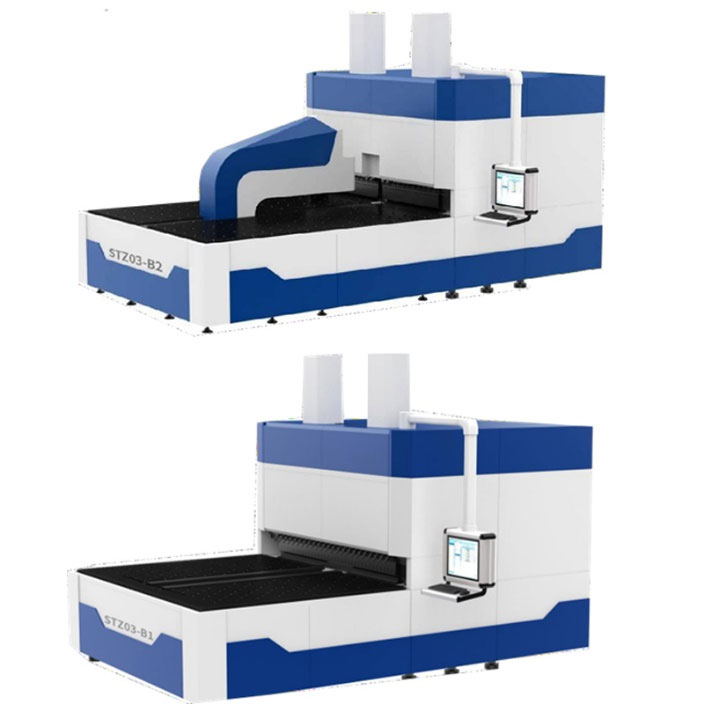
Unlike traditional press brakes that depend on punch-and-die tooling, a sheet metal panel bender uses a fully automated clamp-and-swing bending principle. This advanced technology, widely adopted by leading panel bender manufacturers like Remortechnology, allows the machine to bend multiple edges of a sheet in a single continuous process without manual repositioning, significantly improving efficiency, precision, and overall production consistency.
An automatic panel bender integrates:
Sheet clamping
Positioning
Bending
Rotation
Unloading
into one intelligent system, making it a core piece of equipment in modern smart factories.
The core technology of a panel bending machine is the clamp-and-swing bending method.
Working Principle:
A fixed upper bending blade is mounted on the machine frame
Robotic arms grip and position the sheet
The sheet is clamped and moved up or down against the bending blade
All sides are bent automatically according to a 3D CNC program
This enables a panel bending center to complete complex box parts with:
No tool change
No manual rotation
No operator experience dependency
| Feature | Panel Bender | Press Brake |
|---|---|---|
| Bending Principle | Clamp & swing | Punch & die |
| Tooling | Universal tools | Large die sets |
| Automation | Fully automatic | Mostly manual |
| Changeover | Minutes | Hours |
| Operator Skill | Low | High |
| Production Type | High-mix | Batch |
| Safety | High | Medium |
For flexible production, the industrial panel bender is clearly superior.
1. Limited Part Geometry
Panel benders are optimized for box-type and panel-type parts.
They struggle or cannot handle:
Very small parts (too small to clamp)
Very narrow flanges (typically < 8–10 mm)
Complex 3D shapes (deep formed parts, non-planar geometry)
Parts requiring variable bend angles on the same edge
Parts with internal obstructions
In short: if the part is not basically a flat sheet that becomes a box, a panel bender may not work.
2. Material Thickness and Strength Limits
Panel benders have a narrower material window than press brakes.
Typical ranges:
Mild steel: ~0.4 – 3.0 mm (some heavy models up to 4 mm)
Stainless steel: ~0.4 – 2.0 mm
Aluminum: ~0.5 – 4.0 mm
Limitations:
Not suitable for thick plate
Difficult with high-tensile steel
Problems with springback on very hard materials
For structural or heavy-gauge bending, press brakes are still mandatory.
3. Flange Length Restrictions
Because bending uses swinging blades:
Minimum flange height is limited (usually 6–10 mm)
Maximum flange height is also limited by machine throat depth
Tall flanges can cause collisions with the bending blades
Deep boxes often require press brake instead.
4. Tooling and Profile Constraints
Panel benders mainly do:
90°
Acute angles
Hemming
Simple offsets
They are weak at:
Complex radius bends
Z-bends with varying heights
Decorative or architectural profiles
They cannot replicate the full tooling variety of press brakes.
A modern CNC panel bender offers:
1. High Efficiency
All sides bent in one cycle
3–5x faster than press brakes
2. Extremely Fast Changeover
No tooling setup
Ideal for small batch production
3. Low Tooling Cost
Universal tools instead of hundreds of dies
4. High Precision
±0.1mm accuracy
Consistent bending angles
5. Improved Safety
No operator near bending area
6. Easy Programming
CAD/CAM 3D import
Automatic bend sequences
These advantages explain the fast-growing demand for panel bender for sale globally.
A sheet metal panel bender is widely used in:
Electrical cabinets
Control boxes
IT & telecom racks
HVAC housings
Elevator panels
Metal furniture
Battery enclosures
Any product that requires box-type sheet metal structures is ideal for a panel bending center, especially when sourced from a reliable laser machine factory that ensures high-quality components and precision engineering throughout the production process.
1. Complete Supply Chain Advantage
China offers:
Machine frames
CNC systems
Servo motors
Tooling components
This enables lower panel bender machine price.
2. Control Systems Are Usable but Evolving
Most domestic systems:
Work reliably
Lack deep intelligent algorithms
Compared to international brands, software maturity is still catching up.
What Is ATC in Panel Bender?
ATC (Automatic Tool Change) allows:
Automatic switching of tools
Digital tool selection
Continuous production
Supports complex bending
Enables flexible manufacturing
Improves productivity 20–40%
Most China machines:
Have limited tool sets
Use semi-auto tool stations
Lack real digital calibration
20+ tools
Servo tool magazines
Automatic measurement systems
ATC is still the biggest limitation for China-made machines.
The answer is NO, if quality is the goal.
1. Machine Body Is the Foundation
Weak frame leads to:
Vibration
Accuracy loss
Servo drift
2. CNC System Is Not Everything
Good software must support:
Collision detection
Tool path optimization
Long-term stability
3. Engineering Experience Matters Most
A true best panel bender depends on:
Mechanical design
Assembly accuracy
Installation experience
Real factory feedback
| Aspect | China | International |
|---|---|---|
| Price | Low | High |
| First-year performance | Good | Excellent |
| 3-year stability | Medium | High |
| 5-year accuracy | Uncertain | Stable |
| Automation | Weak | Strong |
| Resale value | Low | High |
China machines win on panel bender machine price.
International brands win on reliability.
1. ATC System
Limited tools
Manual calibration
Low reliability
2. CNC Software
Modified press brake logic
No intelligent algorithms
3. Mechanical Structure
Light frames
Weak heat treatment
Poor vibration control
4. Tooling System
Short tool life
Manual alignment
Inconsistent quality
5. Assembly & Engineering
Lack long-term experience
Short testing cycles
6. Automation Integration
Mostly standalone
Robot integration not standard
7. Lifecycle Risk
Many machines are good in 1–2 years, unstable after 3–5 years.
The future of automatic panel bender includes:
Full robotic integration
Smarter CNC systems
Modular bending centers
Digital twin simulation
MES connectivity
Lights-out factories
The technology gap between China and global brands is narrowing.
Panel Bender Machine Price and Investment Value
Typical panel bender machine price:
Type Price Range
Basic China model USD 40,000–70,000
Mid-level China USD 70,000–120,000
European brands USD 200,000–500,000
China offers unbeatable ROI for small and medium factories.
When selecting the best panel bender, consider:
Frame rigidity
CNC system maturity
ATC capability
Tooling system
After-sales support
Installed base
Software updates
Never choose only by price.
A panel bender is no longer just a bending machine — it is the core of intelligent sheet metal production.
While international brands still lead in:
ATC
Software intelligence
Long-term reliability
China manufacturers offer:
Highly competitive panel bender for sale
Attractive pricing
Rapid technological improvement
For manufacturers pursuing flexibility, automation, and future-ready production, investing in an industrial panel bender or CNC panel bender is a strategic decision that will define competitiveness for the next decade.
 English
 русский
 français
 Deutsch
 Español